First, a word about "right" and "left"
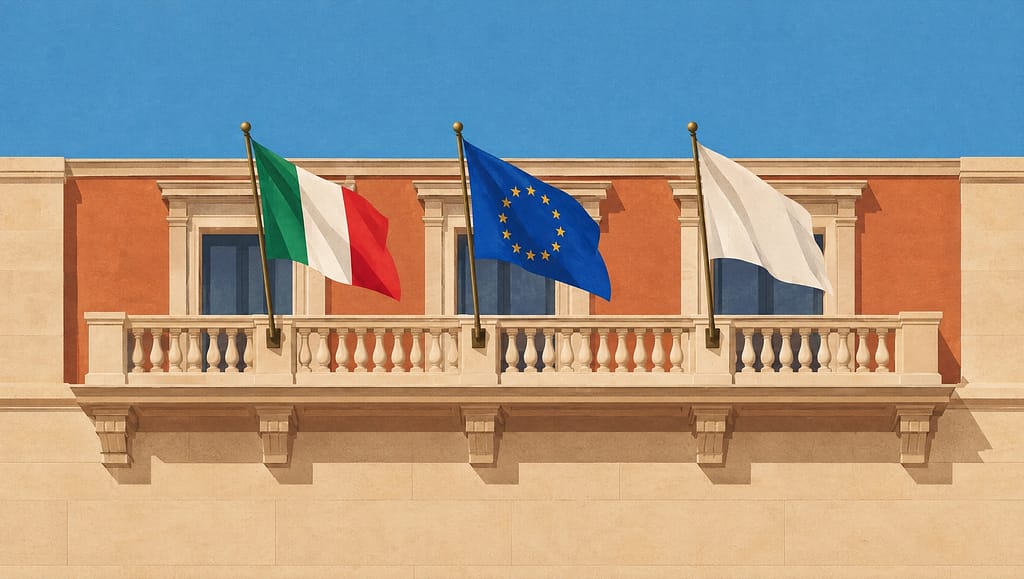
In flag etiquette, positions are counted from the building, looking out at the street. So the place of honour, "first position on the right", is the one on your left when you stand in front of the building. Keep that in mind and everything below makes sense.
Every day, on State buildings
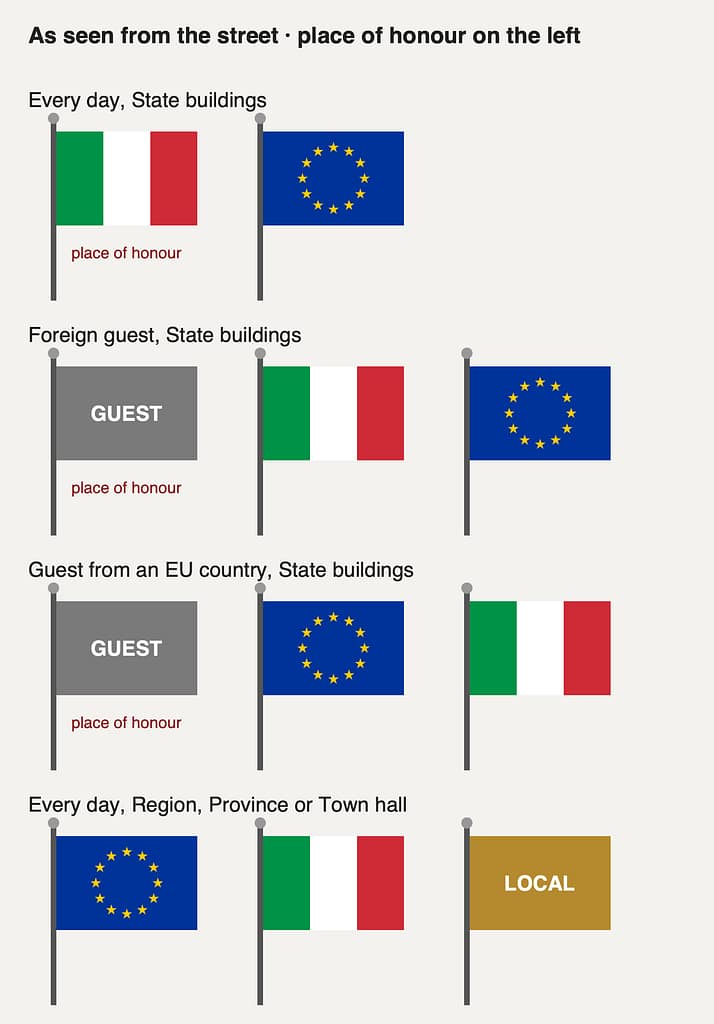
The Italian flag and the flag of the European Union fly together. The Italian flag takes the place of honour: on the left as you look at the building, with the European flag next to it.
When a foreign guest visits
Courtesy comes first. If the visitor's rank is equal to or higher than the host's, the guest's flag takes the place of honour. The Tricolore moves to the centre and the European flag goes to the other side.
If the guest comes from another EU country, the European flag takes the centre instead, and the Italian flag moves to the far side.
On regional, provincial and town halls
Here the local flag or banner joins in. The usual order, from the viewer's left: European flag, Italian flag in the centre, then the flag of the Region, Province or Town.
Three small rules people forget
- One flag per pole. Never two flags on the same pole.
- Nothing written on it. No words, figures or letters on the flag or on its pole.
- In good condition. A faded or torn flag should be replaced, not left to fly.
In mourning, flags fly at half-mast, and two black ribbons may be tied to the top of the hoist.
Where to read the full rules
Everything comes from Law 22/1998 and Presidential Decree 121/2000. The Italian Government's Ceremonial Office explains them, with drawings, on its page Come si espongono le bandiere (in Italian).
Need a flag that looks the part? Have a look at our Zastava Italije and our Evropska zastava.